
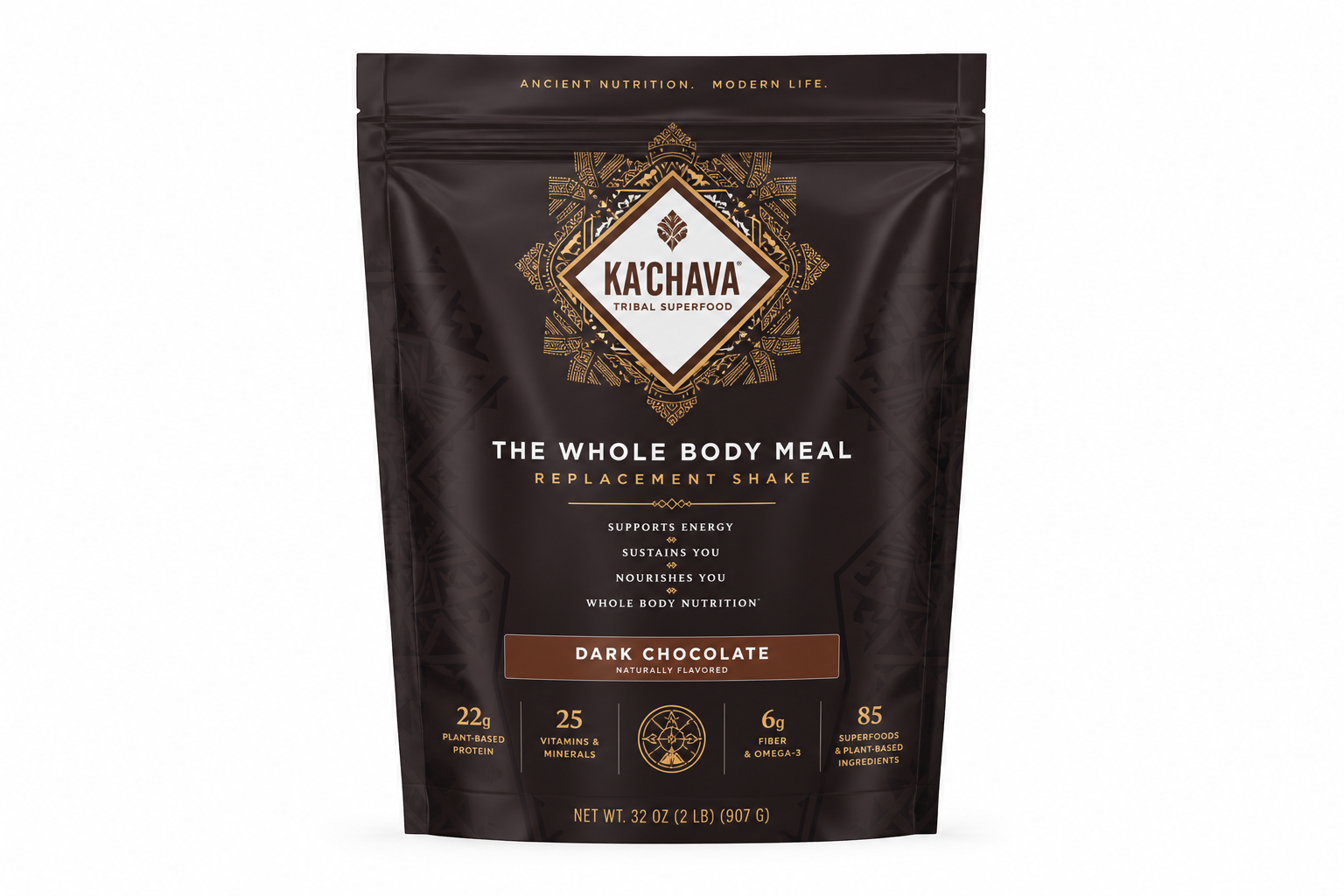
At $4.67 per serving, Ka'Chava positions itself as the premium end of the meal replacement market. With 85+ superfoods on the label and a cult following built through influencer marketing, this plant-based shake from Tribal Nutrition has become one of the most searched-for shakes online. But does the ingredient reality match the marketing? We bought it, tested it, and dug into every line of the label.
What Is Ka'Chava?
Ka'Chava is a plant-based meal replacement shake made by Tribal Nutrition LLC, founded by Simon Malone around 2019 in Oceanside, California. The brand markets itself on an extensive superfood ingredient list spanning proteins, greens, adaptogens, probiotics, and omega fatty acids. It's privately held and has grown primarily through direct-to-consumer sales and aggressive influencer marketing on Instagram and YouTube.
The name "Ka'Chava" is meant to evoke indigenous wisdom and natural purity. The branding leans heavily into the "superfoods" narrative, with each bag prominently displaying the 85+ ingredient count. At face value, the ingredient list is genuinely impressive. The question is whether quantity equals quality.
Nutrition Profile: The Full Breakdown
Macronutrients
Each serving (two scoops) delivers:
- Calories: 240 kcal
- Total Fat: 7g (9% DV) — 2g saturated fat from coconut milk powder
- Total Carbohydrates: 25g (9% DV)
- Dietary Fiber: 6g (21% DV) — from acacia gum and soluble corn fiber
- Total Sugars: 6g — including 4g added sugar from organic coconut nectar
- Protein: 25g (50% DV) — plant blend (pea, brown rice, sacha inchi)
- Sodium: 300-450mg (13-20% DV) — variable batch-to-batch
The macronutrient profile is solid on paper. Twenty-five grams of protein from a diversified plant blend is competitive with the best in category, and the amino acid profile is well-balanced thanks to the pea-rice-sacha inchi combination. The 240 calories are genuinely meal-replacement level.
However, there's a detail Ka'Chava doesn't prominently disclose: 4 grams of added sugar from organic coconut nectar. Coconut nectar sounds clean, but it's functionally added sugar with a glycemic index around 35-54 (still lower than table sugar, but added sugar nonetheless). For a product at this price point, monk fruit or stevia would be the expected choice.
Micronutrients — Where the Premium Price Falls Apart
Here's where things get genuinely disappointing. Despite charging $4.67 per serving, Ka'Chava uses the cheapest synthetic form for virtually every vitamin and mineral:
- Vitamin B12: Cyanocobalamin — the cheapest form available. Contains a cyanide molecule that your body must first remove before converting to the active methylcobalamin form. The premium alternative (methylcobalamin) costs roughly 3-5 cents more per serving.
- Folate: Folic acid — the synthetic form that roughly 40% of the population (those with MTHFR gene variants) can't efficiently convert to the active 5-MTHF form. This isn't a niche concern; it affects nearly half of all humans.
- Magnesium: Magnesium oxide — only 4% bioavailability. This means out of every 100mg on the label, your body absorbs approximately 4mg. Magnesium glycinate or citrate would deliver 20-30% bioavailability at minimal additional cost.
- Zinc: Zinc oxide — among the least bioavailable zinc forms. Zinc picolinate or citrate are significantly better absorbed.
- Vitamin D3: Cholecalciferol at 10 mcg (50% DV) — this one is actually the acceptable D3 form, though only providing half the daily value.
- Vitamin E: dl-Alpha Tocopheryl Acetate — the synthetic racemic form, which includes mirror-image molecules your body can't use as effectively.
At $4.67 per serving, upgrading to methylated B vitamins and chelated minerals would add roughly 18 cents to the cost. Ka'Chava's margins are estimated at 70-80% on direct sales. The margin exists for better ingredients. The will doesn't.
Ingredient Deep Dive
Protein Sources — Genuinely Strong
The protein blend is arguably Ka'Chava's best feature. Yellow pea protein isolate provides the bulk (~70% of total protein) with a strong lysine profile. Organic brown rice protein complements with methionine, creating a complete amino acid spectrum. Sacha inchi protein adds marketing appeal and trace omega-3s but contributes minimal grams. Amaranth and quinoa are listed for amino acid completeness but are at trace levels.
The estimated PDCAAS (Protein Digestibility-Corrected Amino Acid Score) of the blend is approximately 0.85, which is solid for a plant-based product though below whey (1.0) or even soy isolate (0.91-1.0). For context, most people won't notice the difference in real-world protein utilization.
Carbohydrate Sources — Quietly Reclassified
In a noteworthy label change, Ka'Chava's 2026 formulation moved several ingredients out of the "Whole-Food Blend" marketing section:
- Oat milk powder — formerly listed in the fiber/protein blend, now correctly classified as a carb source. It's essentially oat flour + water, contributing oat-derived carbohydrates, not meaningful protein.
- Coconut milk powder — a fat and flavor carrier that contributes saturated fat. Listed under carb sources now.
- Organic coconut nectar — the source of those 4g added sugars. Marketed as "whole food" but functionally equivalent to sweetener.
- Soluble corn fiber — an isolated, processed fiber that pads the fiber count. It's technically fiber, but it's far from the whole-food narrative.
Label Watch: The grams haven't changed between formulations. Only the category placement on the label has. When a brand reclassifies ingredients without reformulating, it usually means consumer pressure or legal scrutiny forced clearer disclosure.
Adaptogen and Greens Blends — Sub-Clinical Dosing
Ka'Chava includes maca, ashwagandha, reishi, lion's mane, cordyceps, and over a dozen greens powders (kale, spinach, chlorella, broccoli, etc.) in proprietary blends. The blends sound impressive, but without disclosed individual doses, clinical efficacy is highly unlikely.
For reference, research-backed doses are: ashwagandha (300-600mg), lion's mane (500-1000mg), maca (1500-3000mg). In a blend that includes 20+ ingredients within a few grams total weight, achieving even one clinically relevant dose is mathematically implausible.
The probiotics (2 billion CFU from Lactobacillus and Bifidobacterium strains) are a nice touch, though the lack of end-of-shelf-life guarantees means the viable count at consumption could be significantly lower than at manufacture.
Taste, Texture, and Mixability
Ka'Chava performs well on taste — this is one area where the brand genuinely delivers. The Chocolate flavor has a rich, earthy profile without the chalky aftertaste common in plant-based shakes. The Vanilla flavor is milder but pleasant. Both mix reasonably well in a shaker bottle, though some grittiness from the whole-food ingredients is noticeable compared to purely processed competitors.
The coconut nectar adds genuine sweetness (not the bitter aftertaste of stevia-only products), and the coconut milk powder contributes creaminess. Taste-wise, Ka'Chava is in the top tier of the category. The question is whether taste alone justifies the premium over competitors that taste 80% as good at half the price.
Who Is Ka'Chava For?
- People who want a protein-rich plant-based shake with real food ingredients and can supplement vitamins separately
- Those who prioritize taste and are willing to pay a premium for it
- Consumers who value the superfood ingredient list for the plant-nutrition diversity (even at sub-clinical doses)
- People without MTHFR gene variants who tolerate folic acid well
Who Should Skip Ka'Chava?
- Anyone with MTHFR variants (40% of the population) — folic acid is the wrong folate form
- Budget-conscious consumers — $4.67/serving with synthetic vitamins doesn't deliver proportional value
- People who expect premium vitamins at a premium price — the micronutrient stack contradicts the price positioning
- Those concerned about ongoing litigation and Prop 65 lead exposure warnings
Legal and Safety Record
Weisman v. Tribal Nutrition LLC
Case: No. 3:25-cv-01184 — S.D. Cal. | Status: Active
This is a class action lawsuit alleging that Ka'Chava's "Whole-Food Blend" marketing is misleading because it includes processed sub-ingredients (like corn fiber and coconut nectar) marketed as whole foods. Notably, the court denied Ka'Chava's motion to dismiss in early 2026, meaning the judge found enough merit for the case to proceed. This is significant — many supplement lawsuits get dismissed early.
California Prop 65 — Lead Warning
Status: Disclosed on packaging
Ka'Chava ships with a Proposition 65 warning for lead exceeding 0.5 µg/day. This is relatively common with products containing cocoa and concentrated greens powders (lead bioaccumulates in these plants). While the levels are below FDA action thresholds, the warning is legally required in California and worth noting for daily consumption products.
Strengths
- Real-food protein base with three complementary plant proteins (pea, brown rice, sacha inchi)
- No artificial sweeteners, colors, or flavors
- Plant-based, vegan, gluten-free, soy-free
- Reasonable fiber content (6g) without psyllium tricks
- Transparent calorie-to-protein ratio (240 cal / 25g protein)
- Actual probiotics included (2B CFU at manufacture)
- Best-in-class taste for a plant-based shake
- Diverse superfood ingredient base (even if underdosed)
Limitations
- ALL synthetic vitamin forms across the board (cyanocobalamin, folic acid, MgO, ZnO)
- Proprietary blend doses for adaptogens and greens mean no clinical verification
- 4g added sugar from coconut nectar — undisclosed in marketing
- Sodium varies 300-450mg batch-to-batch — inconsistent quality control
- Active class-action lawsuit (Weisman v. Tribal Nutrition) with surviving claims
- Prop 65 lead warning required for California sales
- Premium price ($4.67/serving) paired with budget-grade vitamin stack
- No third-party testing certifications (NSF, Informed Sport, USP)
Value Assessment
At $4.67 per serving, Ka'Chava is the most expensive shake in our review. For comparison: Huel costs $2.12/serving with superior vitamin forms (L-Methylfolate, MK-7 K2). Orgain costs $2.00/serving with food-based B vitamins. Even Garden of Life at $3.75/serving uses fermented vitamin sources.
Ka'Chava's price premium buys you better taste, a longer ingredient list, and brand cachet. It does not buy you better vitamins, minerals, or transparency. Whether the tradeoff is worth it depends entirely on what you value most in a daily shake.
Final Verdict
Ka'Chava is a study in contradictions. The protein base is genuinely excellent — the pea-rice-sacha inchi combination provides complete amino acids from real food sources. The superfood ingredients are real (if likely underdosed). The taste is among the best in category.
But the vitamin stack belongs in a product that costs half as much. Every single micronutrient is delivered in the cheapest available form, and at $4.67 per serving, that's not a budgetary constraint — it's a margin choice. The active class-action lawsuit, Prop 65 warning, and batch-to-batch sodium variation add further concern.
If you're buying Ka'Chava purely for the protein and taste and you get your vitamins from a separate high-quality multivitamin, it's a decent choice. If you're paying premium expecting premium nutrition from top to bottom, the synthetic vitamin forms are a dealbreaker that the 85-superfood ingredient count doesn't compensate for.
Score Breakdown
- Nutrition: 6.5/10
- Protein Quality: 7.0/10
- Vitamin Quality: 3.5/10
- Transparency: 3.0/10
- Value: 3.5/10
- Safety & Legal: 5.0/10
- Ingredient Purity: 6.0/10
Overall Score: 6.5/10
Frequently Asked Questions
Is Ka'Chava worth $4.67 per serving?
For the protein base and taste, the price is defensible — comparable real-food plant shakes run $3.50-$5.00. For the micronutrient stack, absolutely not. You're paying premium price for synthetic B12 (cyanocobalamin), folic acid, and zinc oxide — the cheapest forms available. Methylated forms would add roughly 18 cents per serving to Ka'Chava's cost.
Does Ka'Chava have a lawsuit?
Yes. Weisman v. Tribal Nutrition LLC (Case No. 3:25-cv-01184, S.D. Cal.) is an active class action alleging the "Whole-Food Blend" claim is misleading because it includes processed sub-ingredients marketed as whole foods. The court denied Ka'Chava's motion to dismiss in early 2026, meaning the case has enough merit to proceed.
Is Ka'Chava a complete meal replacement?
Functionally yes — 240 kcal and 25g protein provides 4-5 hours of satiety for most people. Nutritionally, it's incomplete for anyone with MTHFR gene variants (40% of the population can't efficiently convert folic acid), and the synthetic mineral forms (especially magnesium oxide at 4% bioavailability) limit actual nutrient absorption.
How does Ka'Chava compare to other shakes in the same price range?
Ka'Chava has one of the strongest whole-food protein bases in the category but the weakest vitamin stack relative to its price point. Huel costs less than half and uses methylated folate and vitamin K2 MK-7. Garden of Life costs $3.75 and uses fermented vitamin sources. Ka'Chava charges the most and uses the cheapest vitamin forms.
Are the adaptogens in Ka'Chava effective?
Unlikely at clinically relevant doses. Research shows ashwagandha requires 300-600mg and lion's mane needs 500-1000mg for measurable effects. Ka'Chava's proprietary blend includes 20+ adaptogen and greens ingredients in a few grams total, making it mathematically implausible that any single ingredient reaches its effective dose.
Does Ka'Chava have heavy metals?
Ka'Chava carries a California Prop 65 warning for lead exceeding 0.5 µg/day. This is common with products containing cocoa and concentrated greens (lead bioaccumulates in these plants). The levels are below FDA action thresholds but above California's conservative warning requirements.
About the Author: This review was written by a certified nutritionist with over 10 years of experience in holistic health and supplementation. We purchased this product independently and received no compensation for this review.
Explore More
📊 See the full rankings: Top Rated Meal Replacement Shakes 2026
📐 How We Score: Our 7-Dimension Methodology
⚖️ Compare Shakes Side-by-Side
📖 Related Reviews: Garden of Life Review (6.5/10) · Huel Review (7.2/10) · Vega One Review (6.0/10)


