
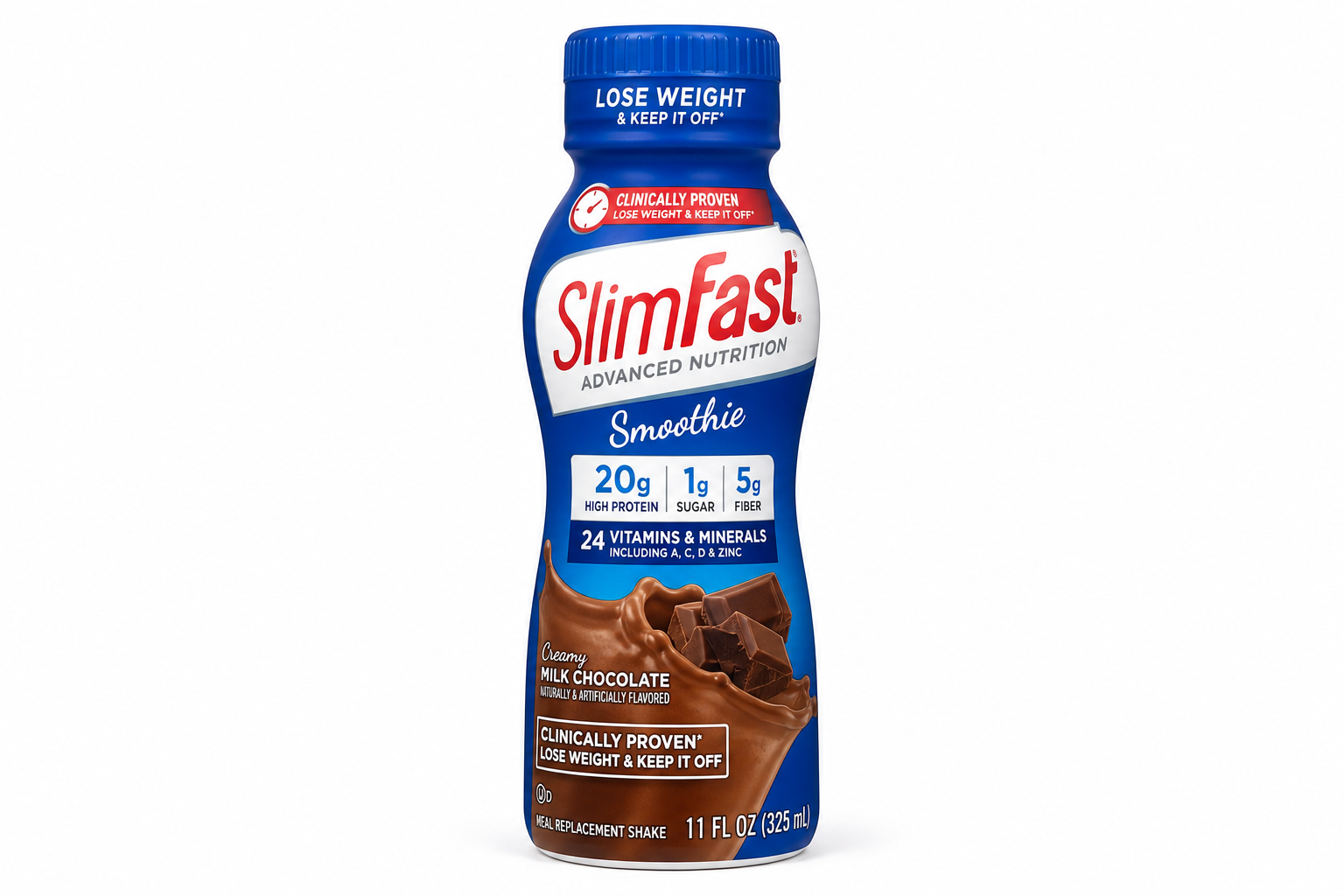
SlimFast has been a household name since 1977 — nearly five decades of "a shake for breakfast, a shake for lunch, then a sensible dinner." It's the diet brand your mom probably tried. But in an era where consumers read ingredient labels, question seed oils, and demand transparency about what's in their food, can a legacy diet brand built on convenience over quality still compete? We bought the current formula to find out.
What Is SlimFast?
SlimFast was founded in 1977 and has been one of the most recognized diet brands in America for nearly 50 years. The original premise was simple calorie restriction through portion-controlled shakes: replace two meals with shakes, eat one "sensible" dinner. It was effective for weight loss in the same way that eating less is always effective — not because of what was in the shakes, but because of what you weren't eating.
However, the company's recent corporate history raises serious questions about product quality and consistency. SlimFast has changed hands three times in just seven years:
- 2017: Sold by KSF Acquisition to Glanbia (an Irish dairy and nutrition company)
- 2019: Glanbia sold SlimFast to Kainos Capital (a private equity firm)
- 2023: Kainos Capital remains the owner as of this review
Each acquisition brings new management priorities, and private equity ownership typically means optimizing margins — which in consumer products usually translates to cheaper ingredients, not better ones. The current formula should be evaluated with that incentive structure in mind.
Nutrition Profile: The Full Breakdown
Macronutrients
Each serving of SlimFast Advanced Nutrition delivers:
- Calories: 180 kcal
- Total Fat: 9g (12% DV) — includes canola oil
- Total Carbohydrates: 7g (3% DV)
- Dietary Fiber: 5g (18% DV) — from processed fiber sources
- Total Sugars: <1g — because sweetness comes from artificial sweeteners
- Protein: 20g (40% DV) — milk protein concentrate
- Sodium: 220mg (10% DV)
The macros look reasonable on paper: 20g protein, low sugar, moderate calories. The "less than 1g sugar" seems impressive — until you realize the sweetness comes from sucralose and acesulfame potassium, not from eliminating sweetness. The sugar was replaced, not removed.
The 5g fiber looks good on the label, but it's from processed fiber sources (polydextrose, cellulose gel), not from whole food fiber that would provide gut health benefits. There's a meaningful difference between fiber from oats or vegetables and fiber from industrially produced polydextrose.
Micronutrients — All Synthetic, Budget-Grade
Every vitamin and mineral form in SlimFast is synthetic:
- Vitamin B12: Cyanocobalamin — cheapest available form
- Folate: Folic acid — problematic for the ~40% with MTHFR variants
- Vitamin D: Cholecalciferol (D3) — actually the acceptable form, one of the few bright spots
- Vitamin E: dl-Alpha-Tocopheryl Acetate — synthetic racemic form
- All minerals: Basic oxide and sulfate forms — lowest bioavailability tier
For a brand that's had nearly 50 years to improve its formula, the all-synthetic approach reflects a company optimized for cost, not quality. At $2.00/serving, margins exist for better forms. But three private equity owners in seven years suggests those margins go to shareholder returns, not ingredient upgrades.
Ingredient Deep Dive
Protein — Conventional Dairy
SlimFast uses milk protein concentrate (MPC) from conventional dairy. No grass-fed certification, no A2 designation, no transparency about farm sourcing. MPC is a cost-effective complete protein — it contains both whey and casein in the natural ratio found in milk, which provides a blend of fast and slow-digesting protein.
The conventional dairy sourcing means potential exposure to hormones (rBGH/rBST) and antibiotics used in industrial dairy farming. While the FDA considers these safe at trace levels, consumers increasingly prefer grass-fed or organic dairy for daily consumption products.
Fats — Canola Oil
SlimFast contains canola oil — an industrial seed oil high in omega-6 fatty acids. As consumer awareness of seed oils grows, this is an increasingly notable ingredient for a product marketed as supporting health and weight management.
Canola oil is cheap, neutral-tasting, and shelf-stable — all advantages for a mass-market product. Whether it belongs in a daily health product is the question consumers are increasingly asking. Alternatives like coconut oil or MCT oil would increase cost by cents per serving.
Artificial Sweeteners — Sucralose + Acesulfame Potassium
SlimFast uses both sucralose and acesulfame-K to deliver sweetness without sugar calories. This double-sweetener approach is common in diet products but increasingly controversial:
- Sucralose: Research published since 2023 has raised questions about effects on gut microbiome diversity, DNA genotoxicity of sucralose metabolites, and insulin signaling. The WHO reclassified sucralose as "not recommended for weight control" in 2023.
- Acesulfame-K: Less studied than sucralose, but preliminary research suggests potential effects on gut bacteria and metabolic processes.
The irony: artificial sweeteners were designed to help weight management, but emerging research suggests they may actually undermine the metabolic processes that support healthy weight. For a diet-focused product, this is a significant philosophical problem.
Carrageenan
Some SlimFast RTD varieties contain carrageenan, a seaweed-derived thickener linked to gastrointestinal inflammation in some studies. The Joint FAO/WHO Expert Committee on Food Additives (JECFA) considers it safe, but many clean-label brands have proactively removed it. It's a processing shortcut that consumers increasingly reject.
Processed Fiber Sources
Polydextrose and cellulose gel are the primary fiber sources. Polydextrose is a synthetic fiber — literally manufactured from glucose and sorbitol in a factory. Cellulose gel is processed plant cellulose used as a thickener. Both technically count as "fiber" on the nutrition label, but neither provides the prebiotic benefits, satiety, or gut health support of whole-food fiber sources like oats, psyllium, or acacia.
Taste, Texture, and Mixability
SlimFast's taste is... familiar. If you've had any diet shake in the last 30 years, you know this flavor profile: aggressively sweet (artificial sweetener sweet, not real sweet), with a chemical undertone that reads as "diet product." The Chocolate flavor is the most tolerable. The Vanilla has a pronounced artificial sweetener aftertaste.
The RTD bottles are smooth and drinkable — the processing is optimized for convenience. The powder version requires more effort to mix smoothly but works adequately in a shaker bottle. Neither format will win taste awards, but neither is unpleasant enough to prevent daily consumption.
Who Is SlimFast For?
- People who want a simple, affordable calorie-restriction tool and don't prioritize ingredient quality
- Those transitioning from fast food to portion-controlled meals (it's a step up)
- Consumers who prioritize convenience and wide retail availability above all else
- Brand loyalists who've used SlimFast for years and prefer the familiar
Who Should Skip SlimFast?
- Anyone who reads ingredient labels and cares about what's in their daily nutrition
- People avoiding seed oils, artificial sweeteners, or carrageenan
- Those seeking genuine whole-food nutrition (this is the opposite)
- Consumers who want transparency about dairy sourcing or ingredient origins
- Anyone aware of the emerging artificial sweetener research
Legal and Safety Record
Ownership Instability
Three owners in seven years is a significant concern. Each acquisition brings new management, new cost targets, and potential reformulation. Private equity ownership (Kainos Capital since 2023) typically operates on 3-5 year exit timelines, meaning the brand is likely being prepared for another sale. Products managed for exit value often see cost-cutting that consumers don't notice until quality degrades.
No active FDA warnings or class-action lawsuits were found against the current formulation. However, the revolving-door ownership makes it harder to assess long-term formula commitment — what you're drinking today may not be what's sold under the SlimFast name in two years.
Strengths
- Affordable at $2.00/serving — among the lowest in category
- Wide retail distribution — available in virtually every grocery store, pharmacy, and big-box retailer
- RTD bottles offer genuine grab-and-go convenience
- 20g protein per serving — adequate for basic protein needs
- Nearly 50 years of brand recognition and consumer familiarity
- Low calorie count (180 kcal) supports calorie restriction goals
Limitations
- Contains canola oil (seed oil)
- Sucralose + acesulfame potassium — two controversial artificial sweeteners
- All synthetic vitamin forms across the board
- Milk protein concentrate from conventional dairy (no grass-fed, no sourcing transparency)
- Three owners in seven years — corporate instability affecting formula continuity
- Carrageenan in some varieties (controversial thickener)
- Polydextrose and cellulose gel as "fiber" — synthetic, not whole-food
- Outdated "diet shake" positioning that hasn't evolved with nutrition science
- Private equity ownership incentivizes cost-cutting over quality improvement
Value Assessment
At $2.00 per serving, SlimFast is among the most affordable options in the category. On a pure cost-per-protein-gram basis, it's competitive. On a cost-per-quality-ingredient basis, you're paying $2.00 for conventional dairy, seed oil, artificial sweeteners, synthetic vitamins, and processed fiber.
Orgain offers organic protein with food-based B vitamins at $2.00/serving. Huel delivers 400 calories with methylated folate at $2.12/serving. The value gap isn't about price — it's about what that similar price buys you in ingredient quality.
Final Verdict
SlimFast is a product frozen in time. The formula reads like it was designed for cost efficiency in the 1990s and never meaningfully updated — canola oil, artificial sweeteners, conventional dairy protein, all-synthetic vitamins, processed fiber, and carrageenan.
The basic premise still works: if you replace a 700-calorie meal with a 180-calorie shake, you'll lose weight. That's arithmetic, not nutrition science. SlimFast delivers calorie restriction. It does not deliver quality nutrition.
At $2.00 per serving, the nationwide retail availability means you can grab one anywhere. If convenience and price are your only criteria, SlimFast technically delivers. But the meal replacement category has evolved dramatically, and SlimFast hasn't kept pace. When competitors at identical price points offer organic proteins, food-based vitamins, and clean ingredient lists, SlimFast's formula isn't just outdated — it's a choice to not improve.
Three private equity owners in seven years tells you everything about where this brand's priorities lie. They're not invested in your nutrition. They're invested in their exit.
Score Breakdown
- Nutrition: 5.0/10
- Protein Quality: 4.5/10
- Vitamin Quality: 2.5/10
- Transparency: 4.0/10
- Value: 5.5/10
- Safety & Legal: 5.0/10
- Ingredient Purity: 2.5/10
Overall Score: 4.2/10
Frequently Asked Questions
Is SlimFast good for weight loss?
SlimFast can create a calorie deficit (180 cal per shake replacing a 500+ cal meal), which leads to weight loss through basic arithmetic. However, the artificial sweeteners may undermine long-term metabolic health — the WHO no longer recommends non-sugar sweeteners for weight control. The processed fiber provides minimal satiety compared to whole-food fiber, meaning hunger management is a challenge.
Why has SlimFast changed owners three times?
SlimFast went from KSF Acquisition to Glanbia to Kainos Capital (2023) in seven years. This pattern — private equity acquiring consumer brands, extracting value through cost optimization, then selling — is common in the food industry and often correlates with ingredient quality degradation over time.
Does SlimFast contain seed oils?
Yes — SlimFast contains canola oil, an industrial seed oil high in omega-6 fatty acids. As consumer awareness of seed oils grows, this is an increasingly scrutinized ingredient in products marketed for health.
Is SlimFast still relevant in 2025?
As a calorie restriction tool, the basic mechanism still works. But the formulation hasn't kept pace with modern nutrition science. Competitors now offer organic proteins, methylated vitamins, and no artificial sweeteners at similar price points. SlimFast is the diet industry equivalent of a flip phone — it technically works, but the category has moved on.
What artificial sweeteners are in SlimFast?
SlimFast uses both sucralose and acesulfame potassium (Ace-K). Both are FDA-approved, but emerging research raises questions about their effects on gut microbiome diversity, insulin signaling, and metabolic health. The WHO issued guidance in 2023 recommending against non-sugar sweeteners for weight management.
Is SlimFast's dairy grass-fed?
No. SlimFast uses milk protein concentrate from conventional dairy with no grass-fed certification, no A2 designation, and no transparency about farm sourcing practices. Conventional dairy may involve rBGH/rBST hormones and antibiotics.
About the Author: This review was written by a certified nutritionist with over 10 years of experience in holistic health and supplementation. We purchased this product independently and received no compensation for this review.
Explore More
📊 See the full rankings: Top Rated Meal Replacement Shakes 2026
📐 How We Score: Our 7-Dimension Methodology
⚖️ Compare Shakes Side-by-Side
📖 Related Reviews: 310 Nutrition Review (4.8/10) · Shakeology Review (4.0/10) · Huel Review (7.2/10)


